Understanding WhatsApp API's Per-Message Pricing
Learn how WhatsApp Cloud API charges for marketing, utility, and service messages, what changes on October 1, 2026, and how CXWizard and Meta billing work together.
WhatsApp Business Platform pricing is per message. Meta charges based on the category of each message you deliver, and rates vary by the recipient's country. This guide focuses on the three categories you will use most often with CXWizard: marketing, utility, and service.
For official rate cards and the full pricing model, see Meta's Pricing on the WhatsApp Business Platform documentation.
How per-message pricing works
Meta bills when a message is delivered to the customer. The charge depends on:
- Message category (marketing, utility, service, and other categories such as authentication / OTP)
- Recipient country (based on the customer's WhatsApp phone number calling code)
Template messages (marketing, utility, authentication) can be sent outside of an open conversation. Non-template replies, which CXWizard uses for AI responses and inbox replies, are service messages. Those can only be sent while a 24-hour customer service window is open. That window opens and resets each time the customer messages you.
Other categories exist too, such as authentication (OTP) messages. Those are important for login and verification flows, but this article focuses on marketing, utility, and service.
Marketing messages
Marketing messages are template messages used to promote products, run campaigns, announce sales, or re-engage customers. You typically send them when there is no open customer service window, for example from CXWizard campaigns.
- Always charged when delivered (unless a free entry point window applies; see below)
- Must use an approved WhatsApp message template in the marketing category
Example: A cart abandonment reminder or a new product launch blast.
Utility messages
Utility messages are template messages for transactional updates like order confirmations/reminders or it can be a simple message to apologize to a customer for a late reply so that the 24 hour conversation window can be re-opened when they reply.
Service messages
Service messages are non-template replies you send after a customer has messaged you. In CXWizard, that includes:
- AI agent responses
- Human replies from the shared inbox
Until now, Meta has not charged for these service replies. That changes on October 1, 2026, with an important free monthly allowance (see below).
October 1, 2026: Service messages become billable (with a free monthly tier)
Effective October 1, 2026, Meta will charge for service messages on a per-message basis. According to Meta, service message rates will match the rates for utility (and authentication) messages in each market. Meta plans to publish the exact rates that take effect on that date by September 1, 2026.
Meta is also introducing a free monthly tier of service messages:
- Each month, every phone number receives 1,000 free service messages
- Only the 1,001st message onward incurs a charge
- Unused free messages do not roll over; the allowance refreshes monthly, by phone number
What this means in practice:
- The first 1,000 AI replies and inbox replies delivered each month on a given WhatsApp number are free from Meta
- Volume above that free tier incurs a small Meta charge when the message is delivered
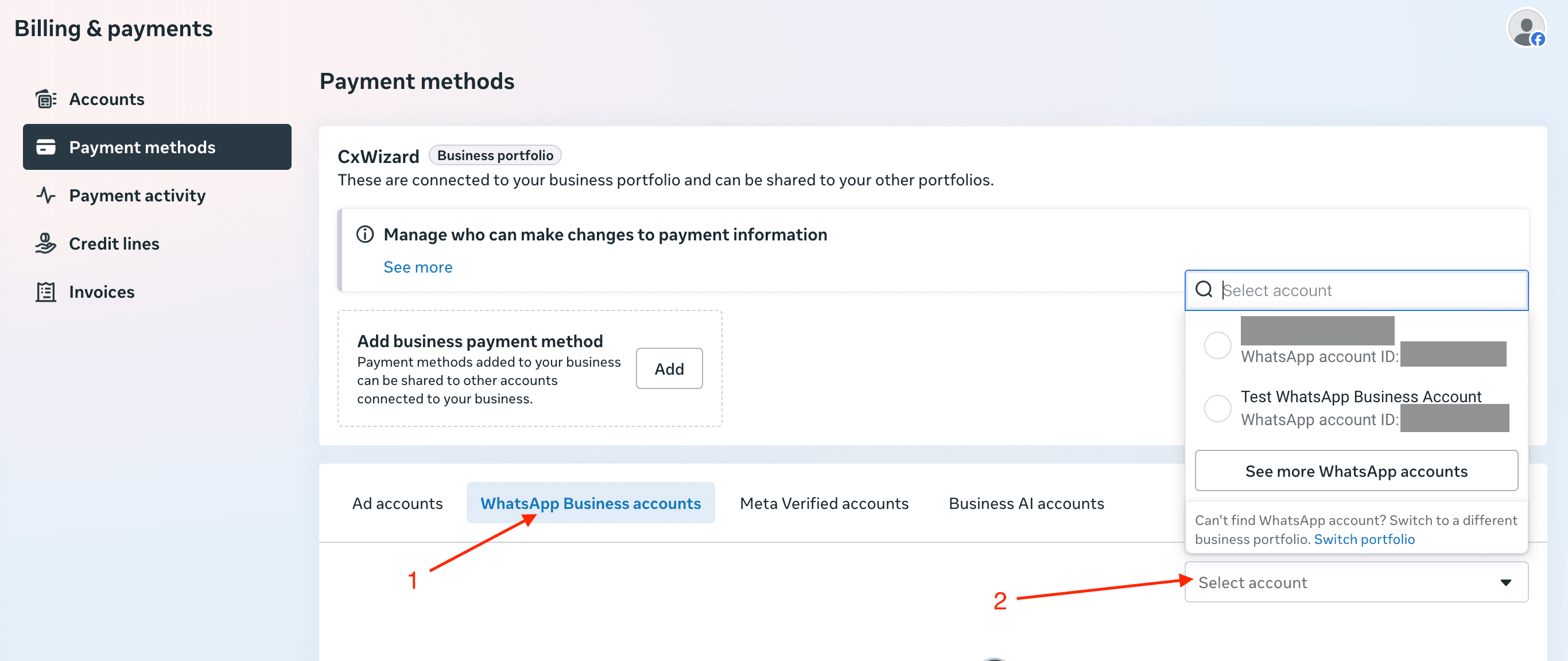
- You must have a valid payment method on your WhatsApp Business account in Meta Business Manager so Meta can bill for deliveries beyond the free tier (and for marketing/utility messages). If you do not have a payment method, billable deliveries (including service messages after the free allowance) will fail
- CXWizard subscription fees and Meta message fees are separate. You pay CXWizard for the product (AI, inbox, campaigns, and related features). You pay Meta directly for WhatsApp message delivery
If you have not added a payment method to your Meta Business account yet, follow How to Add a Payment Method to Your WhatsApp Business Account.
Free entry point (FEP) windows
A free entry point window is a 72-hour period where Meta does not charge for message delivery, including template messages.
It applies when a WhatsApp user messages you from:
- A Click to WhatsApp ad, or
- A Facebook Page Call-to-Action button
The customer must use WhatsApp on a mobile device (Android or iOS). Desktop and web WhatsApp are not supported for opening an FEP window.
How it works:
- The customer messages you from the ad or Page CTA. A normal 24-hour customer service window opens.
- If you reply within 24 hours with any message type, that reply is free, and a 72-hour FEP window starts from the time you responded.
- While the FEP window is open, you can send messages to that user at no Meta delivery charge.
- The customer service window is separate. If the 24-hour window closes, you can still use the remaining FEP time for template messages only, not free-form service replies.
FEP is useful for ad-driven and Page-driven conversations. It does not remove the need for a payment method once service messages become billable for conversations that start outside an FEP window, especially once you exceed the monthly free service-message allowance.
Cost example after October 1, 2026
After October 1, 2026, a business running CXWizard will typically pay two layers of cost:
- CXWizard subscription (for example Hobby at $40/month, Starter at $100/month, or Pro at $290/month)
- Meta per-message fees for delivered marketing, utility, and service messages beyond the free service-message tier (billed to the payment method on your WhatsApp Business account)
Service messages will be priced like utility messages. Using current published utility rates as a stand-in (Meta will confirm October 1, 2026 rates by September 1, 2026):
| Market | Approximate utility / service rate (USD) |
|---|---|
| Brazil | $0.0068 per message |
| Mexico | $0.0085 per message |
| India | $0.0014 per message |
Example: India ecommerce brand on Starter
Assume an India business on the Starter plan ($100/month) that, in one month, delivers:
- 2,000 marketing template messages to Indian customers at $0.0118 each
- 8,000 service messages (AI + inbox replies inside the 24-hour window) at $0.0014 each
With the free monthly tier, the first 1,000 service messages are free, so Meta bills 7,000 service messages:
| Cost | Calculation | Amount |
|---|---|---|
| CXWizard Starter | Flat monthly subscription | $100.00 |
| Meta marketing | 2,000 × $0.0118 | $23.60 |
| Meta service | 7,000 × $0.0014 (after 1,000 free) | $9.80 |
| Total estimated for the month | $133.40 |
Before October 1, 2026, the same month would have cost about $123.60 (CXWizard + WhatsApp marketing fees), because all 8,000 service replies would have been free from Meta. After the change, the extra $9.80 is Meta's charge for service delivery above the free allowance.
Example: Brazil support volume on Hobby
A Brazil-focused brand on Hobby ($40/month, 1,000 AI replies included) sends 1,000 service replies in a month to Brazilian numbers. Those 1,000 replies fall entirely within Meta's free monthly service-message tier, so Meta service fees are $0:
| Cost | Calculation | Amount |
|---|---|---|
| CXWizard Hobby | Flat monthly subscription | $40.00 |
| Meta service | 1,000 free (within monthly allowance) | $0.00 |
| Total estimated for the month | $40.00 |
If that same brand later grows past 1,000 service deliveries on the number, only the overflow is charged. For example, 1,500 deliveries would mean 500 billable messages at $0.0068 each ($3.40).
Rates differ by country, and marketing volume can dominate the Meta bill for outbound campaigns. Always check the latest Meta rate cards for your markets.
What to do before October 1, 2026
- Add a payment method to your WhatsApp Business account (see the payment method tutorial).
- Review how many service replies you typically send per phone number, and estimate Meta costs for anything above the 1,000 free monthly allowance.
- Bookmark Meta's pricing documentation and watch for the September 1, 2026 rate announcement.
Related tutorials
- How to Add a Payment Method to Your WhatsApp Business Account: Add a card in Meta Business Manager so Meta can bill for WhatsApp messages.
- How to Connect Your WhatsApp Business Account to CXWizard: Connect WhatsApp so you can use AI replies, inbox, and campaigns.
- How to Let AI Manage Your Inbox in CXWizard: Configure AI tagging and team escalation for WhatsApp conversations.